

Gasoline Direct Injection Market Register a CAGR of 8.12%, Driving Demands, Technology and Global Trends Till 2035
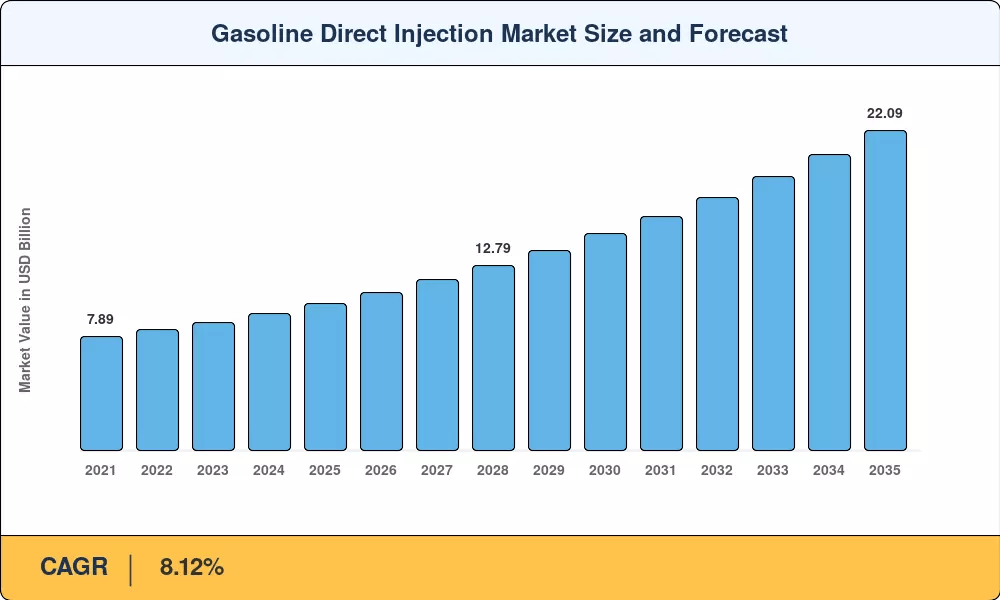
Gasoline Direct Injection (GDI) Market Summary
Asia-Pacific held the leading position in the GDI Market with 41% share; the region's CAGR of 8.31% also makes it the fastest-growing geography through 2035.
Fuel injectors accounted for the largest share — approximately 38% — of the Gasoline Direct Injection Market in 2024, reflecting high unit content per engine.”
NY, CA, UNITED STATES, July 14, 2026 /EINPresswire.com/ -- Gasoline Direct Injection (GDI) is an advanced fuel delivery technology that injects gasoline directly into the combustion chamber of an internal combustion engine, enabling precise fuel control, improved combustion efficiency, and enhanced engine performance compared to traditional port fuel injection systems . Unlike conventional systems that mix fuel with air in the intake port, GDI systems utilize high-pressure fuel pumps capable of generating pressures up to 350 bar, precision-engineered injectors with multiple spray patterns, advanced fuel rail systems, and comprehensive electronic control units (ECUs) that coordinate fuel delivery with ignition timing and air intake management.— Arti Dhapte
A typical GDI system comprises fuel injectors, ECUs, sensors, high-pressure pumps, and fuel rails that work in concert to deliver fuel at optimal timing and quantities, resulting in improved fuel economy, reduced emissions, and increased power output . The technology has become the cornerstone of modern gasoline engine design, particularly in turbocharged and downsized powertrains, as it enables manufacturers to achieve higher thermal efficiency while meeting increasingly stringent emission standards .
Gasoline Direct Injection (GDI) Market Overview
The Gasoline Direct Injection market share is positioned for robust growth through 2035, driven by tightening emission regulations, the global trend toward engine downsizing and turbocharging, the integration of GDI with hybrid powertrains, and the expansion of GDI adoption across vehicle segments. The projected valuation of USD 22.09 billion, growing at a CAGR of 8.12%, reflects GDI's enduring relevance as a cornerstone technology for internal combustion engines and hybrid powertrains.
The market is experiencing robust growth driven by several fundamental factors. Stringent emission regulations—including Euro 7 in Europe, China's CN7 framework, India's BS6 Phase II, and US EPA standards—are the single strongest catalyst, compelling automakers to retrofit or redesign powertrains around high-pressure fuel delivery architectures . GDI technology enhances fuel efficiency by 10–15% compared to port fuel injection systems, making it a critical component in meeting fleet-wide fuel economy targets . The global trend toward engine downsizing and turbocharging—replacing naturally aspirated 2.0–2.5-litre units with 1.0–1.5-litre turbocharged engines—relies on precise fuel metering to sustain power density . According to a 2024 SAE study, three-cylinder turbocharged engines improved brake-specific fuel consumption by 12–18% compared to equivalent port-injection predecessors . Additionally, the integration of GDI with hybrid powertrains is extending the relevance of the technology well beyond pure internal combustion engine timelines .
Industry trends indicate a decisive shift toward high-pressure injection systems and intelligent combustion management. A sweeping shift away from traditional port-fuel-injection systems is reshaping combustion engineering, with engine downsizing and turbocharging strategies depending on precise fuel metering at pressures exceeding 350 bar . Next-generation piezoelectric injector platforms now deliver sub-10-micron droplet size for superior atomization . The integration of edge-computing ECUs capable of cycle-by-cycle injection timing adjustments will become standard by 2028—Bosch's latest platform processes over 20,000 data points per second from in-cylinder pressure sensors, enabling real-time optimization that cuts particulate emissions by an additional 15% beyond hardware-only gains . Over-the-air (OTA) fuel-mapping updates via connected ECUs are creating a new software-recurring revenue model, with Bosch and Continental launching subscription-based calibration platforms that allow fleet operators to tune fuel economy profiles remotely .
Technological developments continue to advance GDI capabilities. Continuous innovation in piezo injectors and pressure-sensor integration improves spray atomization and combustion stability . Advanced multi-hole injector designs improve fuel distribution, leading to better engine performance and lower particulate emissions . The development of high-pressure fuel pumps with aluminum-alloy housings achieving weight reductions of up to 20% demonstrates the industry's focus on efficiency and performance . The emergence of AI-powered control systems enables real-time adjustments, improving fuel efficiency and reducing NOx and CO₂ emissions .
Policy and regulatory influence on the GDI market is profound and growing. Euro 7 standards, expected for new type-approvals from 2027, will lower allowable particulate number limits under real-driving-emission conditions by up to 50% relative to Euro 6e . The combined regulatory push affects an estimated 65 million vehicles per year by 2028 . In the US, the EPA's proposed regulations aim for a 30% reduction in greenhouse gas emissions from light-duty vehicles, driving GDI adoption . China's CN7 framework and India's BS6 Phase II similarly compress allowable hydrocarbon and NOₓ emissions, compelling OEMs to adopt multi-hole injectors operating at pressures above 350 bar . Infrastructure investment commitments from OEMs exceeding USD 8 Billion between 2024 and 2028 reinforce the capital pipeline behind this technology transition .
The demand outlook for GDI systems remains strongly positive, despite the long-term trajectory of vehicle electrification. The passenger cars segment is pivotal to the market, driven by consumer demand for fuel-efficient vehicles and stringent emissions mandates . SUVs and MUVs command approximately 41% of market value, as consumer preference for utility segments keeps displacement elevated . The global SUV registrations surpassed 38 million units in 2024, accounting for 47% of light-vehicle sales, and these larger platforms typically pair 2.0-litre or larger displacement GDI engines . While BEV penetration reached approximately 18% of global new-car sales in 2024 and is projected to approach 35% by 2030 in Europe, the IEA projects hybrid powertrains will account for 30% of global new-car sales by 2030—every hybrid sold requires a combustion core, and GDI remains the default architecture .
📍 Get Free Sample Report for Detailed Market Insights:
https://www.marketresearchfuture.com/sample_request/5041
Gasoline Direct Injection (GDI) Market Segmentation
By Component
The GDI market is segmented by component into Fuel Injectors, Engine Control Units, Sensors, and Other Components. Fuel injectors accounted for the largest share—approximately 38%—of the market in 2024, reflecting high unit content per engine . Premium injector sets incorporating multi-pulse capability now exceed USD 45 per unit . OEM demand is consolidating around suppliers with vertically integrated solenoid and nozzle manufacturing. Sensors represent the fastest-growing segment, poised to register a CAGR of 8.24% through 2035, driven by increasing demand for closed-loop combustion feedback in downsized engines . The migration from open-loop to closed-loop combustion management—demanded by Euro 7 certification—is the primary accelerant behind sensor proliferation . Engine Control Units represent a significant segment, with software-defined combustion strategies enabling OTA calibration and edge-computing ECUs .
By Engine Type
Engine type segmentation includes Inline-3, Inline-4, V6, and V8. Inline-4 configurations dominate the market with roughly 67% share, aligning with the global preference for compact four-cylinder turbo architectures . This architecture's balance of cost, refinement, and emission performance makes it the anchor specification across Volkswagen, Hyundai-Kia, and Toyota product lines . Inline-3 engines are forecast to grow at the fastest pace (8.27% CAGR), driven by micro-car and mild-hybrid adoption in emerging economies where every gram of CO₂ matters . V6 engines serve performance SUV and truck applications, while V8 configurations maintain a presence in the North American full-size segment .
By Vehicle Type
Vehicle type segmentation includes SUVs & MUVs, Sedan, Hatchback, Pick-Up Truck, and Van. SUVs and MUVs commanded approximately 41% of market value in 2024, driven by larger displacement engines that require higher injector content . A turbocharged 2.0-litre SUV engine contains roughly 30% more injector and sensor value than a 1.5-litre sedan powertrain . The sedan segment remains the second-largest by absolute value, sustained by strong production volumes in China, India, and Europe . Hatchbacks represent the fastest-growing vehicle segment, driven by emerging-market GDI transition and BS6 Phase II compliance .
By Sales Channel
Sales channel segmentation includes OEM and Aftermarket. OEM channels retained a dominant share exceeding 83% in 2024, as GDI systems are factory-mandated for emission certification . The aftermarket channel is growing at an 8.29% CAGR, driven by the aging GDI vehicle parc and service demand . By 2028, the worldwide GDI vehicle parc will exceed 350 million units, creating a recurring revenue stream from injector cleaning, high-pressure pump replacement, and intake-valve carbon cleanup .
By Region
Regional segmentation includes North America, Europe, Asia Pacific, South America, and the Middle East and Africa. Asia-Pacific held the leading position with 41% share in 2024 and also represents the fastest-growing geography at a CAGR of 8.31% through 2035 . Europe follows with roughly 28% share, anchored by the stringent regulatory landscape, while North America accounts for approximately 22% .
🛒 You can buy this market report at:
https://www.marketresearchfuture.com/checkout?currency=one_user-USD&report_id=5041
Gasoline Direct Injection (GDI) Market Competitive Landscape / Key Players
The GDI market exhibits medium concentration, with the top five suppliers accounting for an estimated 58–65% of global revenue . Competition centers on injector precision, system integration capability, and software-defined calibration platforms. The Herfindahl-Hirschman Index is estimated in the 1,200–1,500 range, reflecting a moderately concentrated structure where scale economies deter new entrants but do not preclude regional specialists . Key players include Robert Bosch GmbH, Continental AG, DENSO Corporation, BorgWarner Inc., Hitachi Astemo, Marelli Holdings, Stanadyne LLC, Hyundai Kefico, Vitesco Technologies, and Mitsubishi Electric .
Robert Bosch GmbH is the market leader with an estimated 15–18% revenue share, offering HDEV6 injectors, ECUs, high-pressure pumps, and full-system integration with OTA calibration . Bosch's latest platform processes over 20,000 data points per second from in-cylinder pressure sensors . Continental AG holds 12–15% share, specializing in piezo/solenoid injectors and engine management with premium European OEM partnerships . DENSO Corporation commands 10–13% share, providing multi-hole injectors and sensor modules as the Toyota ecosystem anchor supplier . BorgWarner Inc. holds 7–10% share, focusing on GDI pumps and dual-injection systems with post-Delphi integration and hybrid focus . Hitachi Astemo (6–8%) and Marelli Holdings (4–6%) serve Japanese and European OEM platforms respectively .
Strategic developments include ongoing investments in higher-speed GDI technologies, collaborations with automotive OEMs on next-generation powertrain architectures, and the acquisition of technology companies to strengthen market position . Companies are focused on developing solutions for hybrid-GDI integration, integrating security features into ECU software, and building development ecosystems to support OEMs through regulatory transitions .
Latest Industry News & Developments
Recent industry developments highlight the accelerating momentum of the GDI market. In November 2024, Marelli announced the launch of a new AI-based Electronic Control Unit designed for engine and vehicle control in motorsport applications, supporting various propulsion systems from internal combustion to electric powertrains . This development reflects the broader trend toward intelligent combustion management and software-defined calibration .
In October 2024, BorgWarner extended its transfer case business with a major North American OEM, agreeing to supply Electro-Mechanical On-Demand (EMOD) and Electric Shift-on-the-Fly (ESOF) transfer cases for upcoming combustion and hybrid vehicle platforms . The company's post-Delphi integration is strengthening its GDI pump and dual-injection system capabilities .
In October 2023, Stanadyne LLC launched a next-generation GDI pump rated for continuous operation at 350 bar, achieving a 20% weight reduction through aluminum-alloy housing . The European Commission published the final Euro 7 regulatory text in July 2024, confirming particulate number limits applicable from July 2027 for new type-approvals . In April 2025, ENEOS, alongside automakers like Suzuki, Toyota, and Mazda, announced a collaboration to advance carbon neutrality by using synthetic fuel in vehicles at the Expo 2025 Osaka, Kansai, Japan, demonstrating GDI's role in alternative fuel compatibility .
Gasoline Direct Injection (GDI) Market Challenges & Opportunities
Key restraints facing the GDI market include high initial costs, with a complete GDI fuel system adding USD 250–400 per vehicle compared to conventional port injection . Carbon deposit formation on intake valves requires cleaning every 60,000–80,000 km, adding approximately USD 150–250 per interval, which can deter budget-conscious consumers . Particulate matter emissions inherent in GDI combustion require sophisticated aftertreatment systems including gasoline particulate filters that add complexity and cost . Battery-electric vehicle displacement poses a looming challenge, as BEV penetration removes an estimated 600,000 GDI-equipped units per percentage point of share from annual production . Fuel quality sensitivity requires high-octane gasoline for optimal performance, which may not be readily available in all markets . Supply chain concentration risks and semiconductor availability fluctuations further constrain production .
Emerging opportunities in the market are substantial and diverse. Hybrid-electric architecture expansion creates significant opportunities, with OEMs continuing to select high-efficiency GDI combustion cores as full-hybrid and plug-in hybrid sales ramp up to a projected 25 million units per year by 2030 . The aftermarket represents a growing revenue stream as the worldwide GDI vehicle parc exceeds 350 million units by 2028 . Emerging-market regulatory adoption in countries like Brazil (PROCONVE L8) and Saudi Arabia (SASO) provides greenfield prospects for GDI system vendors . Data-driven calibration services via OTA fuel-mapping updates create new software-recurring revenue models . Advanced fuel compatibility engineering for E20–E25 ethanol-blend mandates in India and Brazil requires recalibrated GDI systems, offering differentiated opportunities for suppliers investing in corrosion-resistant materials .
Future potential lies in the development of ultra-high-pressure injection systems exceeding 500 bar, the integration of AI-driven predictive maintenance and self-adjusting injection systems , the adoption of biofuels and synthetic fuels in GDI engines , and the continued optimization of GDI for hybrid powertrain applications. The prevailing narrative of ICE obsolescence overlooks hybrid powertrains, which will account for 30% of global new-car sales by 2030, ensuring GDI relevance well into the mid-2030s .
To explore more market insights, visit us at:
https://www.marketresearchfuture.com/reports/gasoline-direct-injection-market-5041
The medium-term growth outlook remains strongly positive, supported by Euro 7, CN7, and BS6 Phase II regulatory timelines, the expansion of SUV and light-truck production, and the growing aftermarket replacement demand. Asia-Pacific will continue to lead market expansion with 41% share and the fastest growth trajectory, while Europe and North America maintain significant positions through regulatory-driven adoption and premium vehicle production.
Long-term industry potential extends beyond the current forecast horizon, as the convergence of hybridization, intelligent combustion management, and alternative fuel compatibility creates new opportunities for GDI innovation. The development of AI-powered control systems, edge-computing ECUs, and OTA calibration platforms will transform GDI from a hardware-centric technology to a software-defined platform generating recurring revenue. Companies that successfully invest in advanced injector technology, AI integration, hybrid-GDI optimization, and sustainable fuel compatibility will capture disproportionate value. As the automotive industry navigates the transition to electrification, GDI will remain essential to enabling efficient, compliant, and high-performance internal combustion engines and hybrid powertrains across the global vehicle fleet.
More Related Reports from MRFR Library:
https://www.marketresearchfuture.com/reports/online-car-buying-market-29780
https://www.marketresearchfuture.com/reports/railcars-leasing-market-29885
https://www.marketresearchfuture.com/reports/motorcycle-instrument-cluster-market-30858
https://www.marketresearchfuture.com/reports/automotive-efuse-market-31481
https://www.marketresearchfuture.com/reports/intralogistics-automation-solution-market-33134
https://www.marketresearchfuture.com/reports/ev-charger-operation-maintenance-service-market-33233
https://www.marketresearchfuture.com/reports/fuel-cell-bike-market-33401
https://www.marketresearchfuture.com/reports/automotive-water-pump-market-34560
https://www.marketresearchfuture.com/reports/e-bike-rental-market-35290
https://www.marketresearchfuture.com/reports/electric-autonomous-vehicles-wiring-harness-market-35296
Larry Wilson
WantStats Research And Media Pvt. Ltd.
+1 855-661-4441
email us here
Visit us on social media:
LinkedIn
Facebook
YouTube
X
Legal Disclaimer:
EIN Presswire provides this news content "as is" without warranty of any kind. We do not accept any responsibility or liability for the accuracy, content, images, videos, licenses, completeness, legality, or reliability of the information contained in this article. If you have any complaints or copyright issues related to this article, kindly contact the author above.
